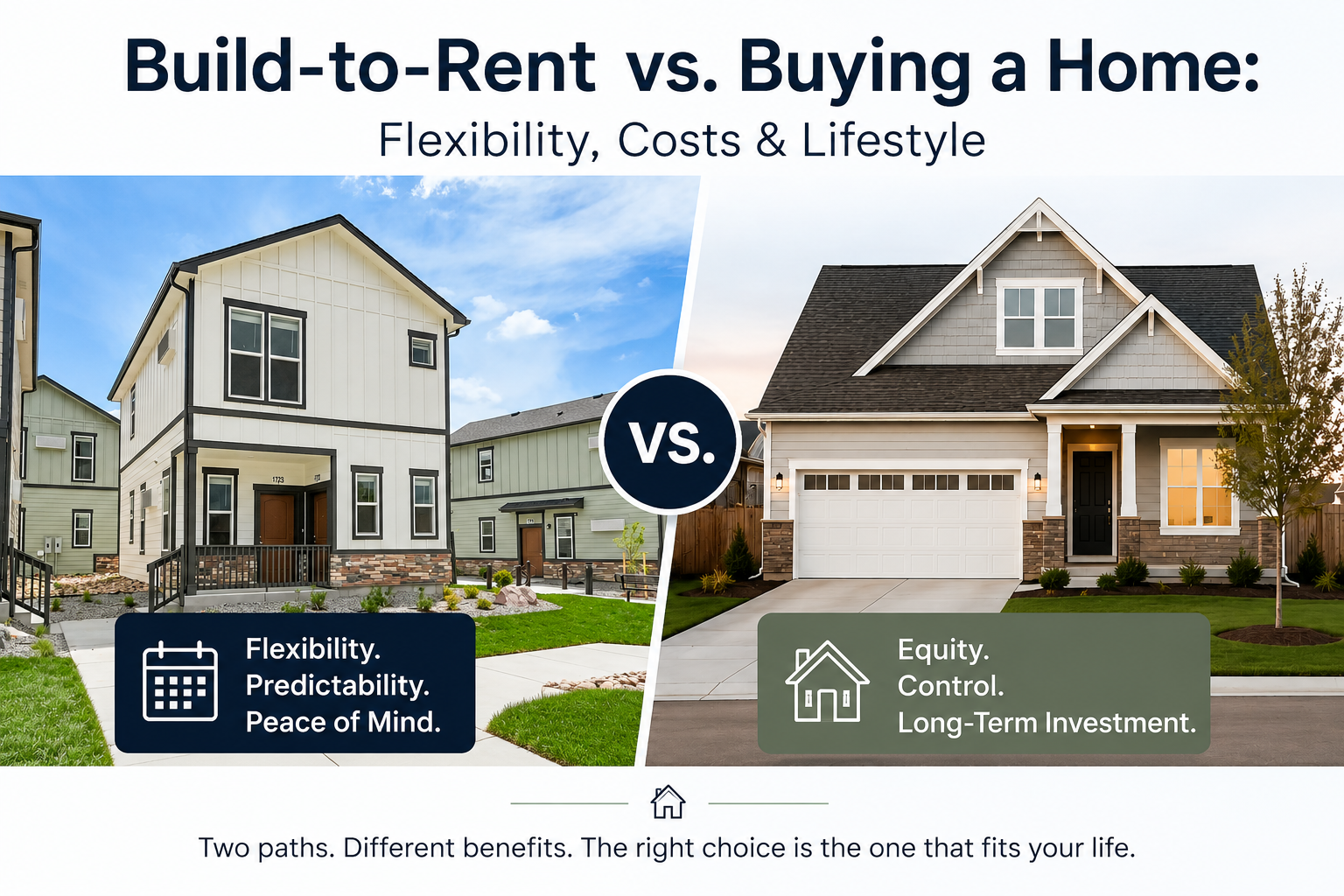

Build-to-Rent vs. Buying a Home: Flexibility, Costs & Lifestyle
August 25, 2026

For generations, homeownership has been treated as the natural destination of the American housing journey.
You rent an apartment. You save money. You buy a starter home. Eventually, you move into something larger.
But housing decisions aren't always that linear anymore.
Some people aren't financially ready to purchase a home. Others could buy but aren't convinced that tying up their savings, taking on a mortgage, and assuming responsibility for a property makes sense for their current stage of life.
And an increasing number of longtime homeowners are asking an entirely different question:
I've owned the house. Do I still want everything that comes with owning it?
Build-to-Rent creates another option.
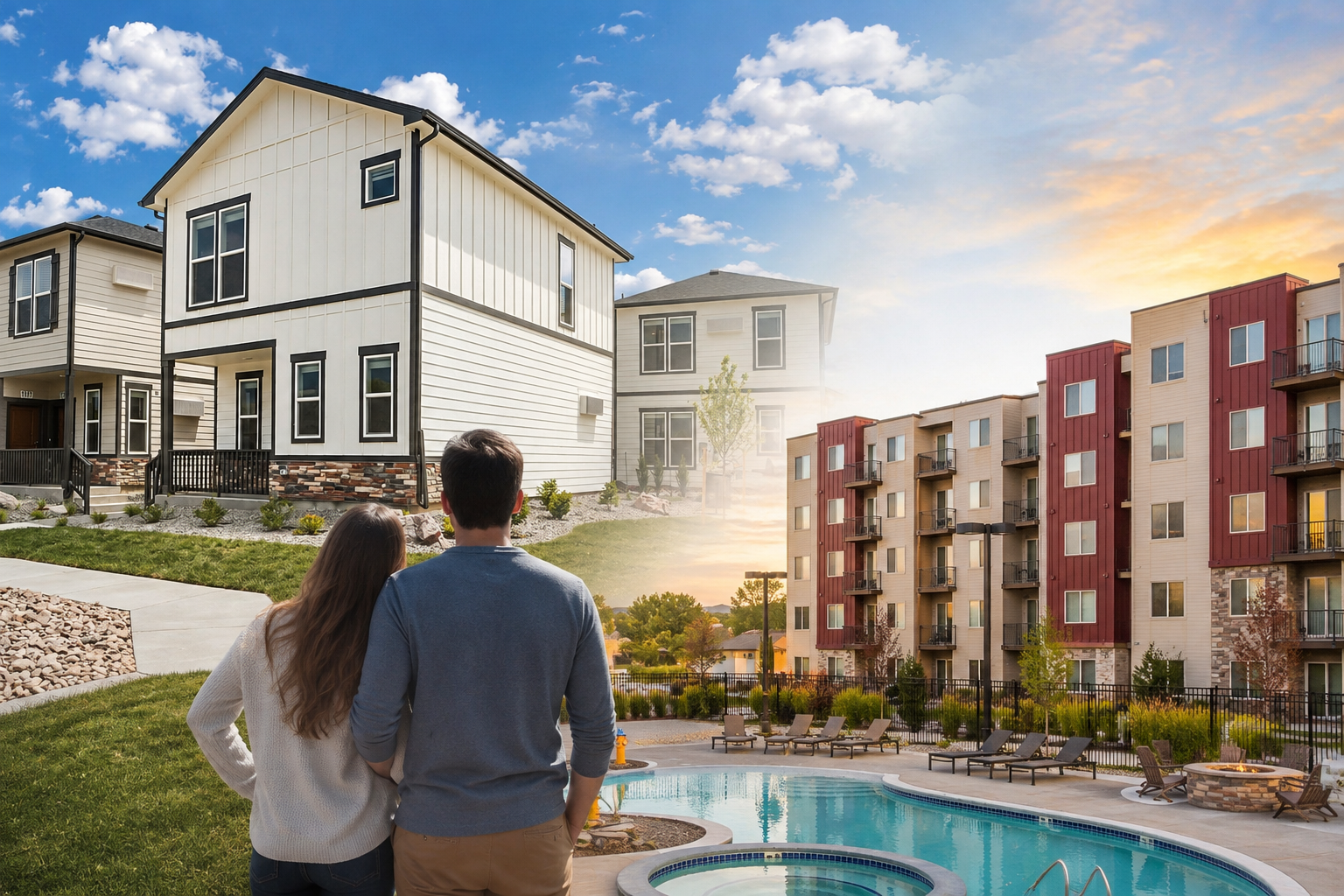
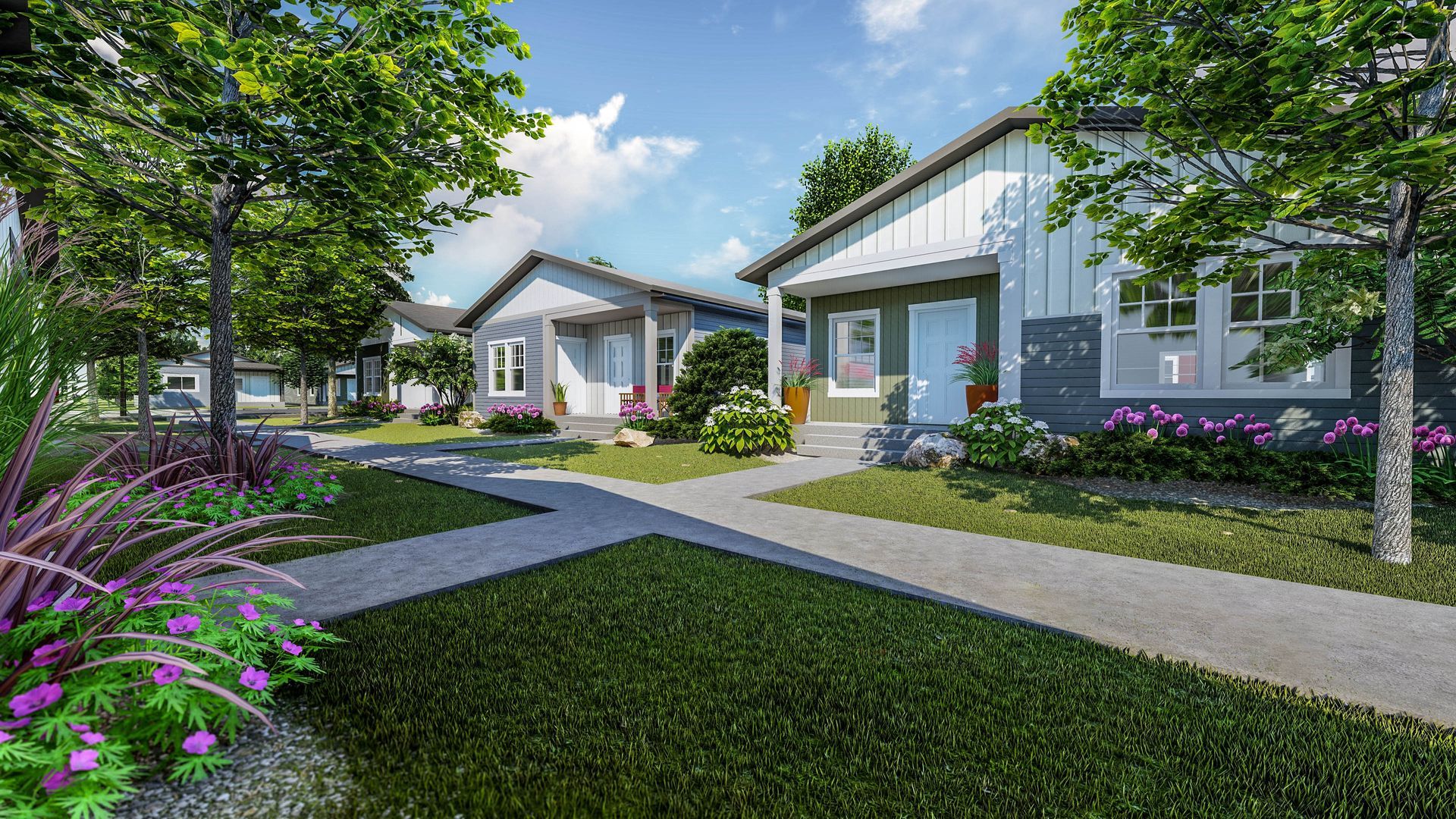
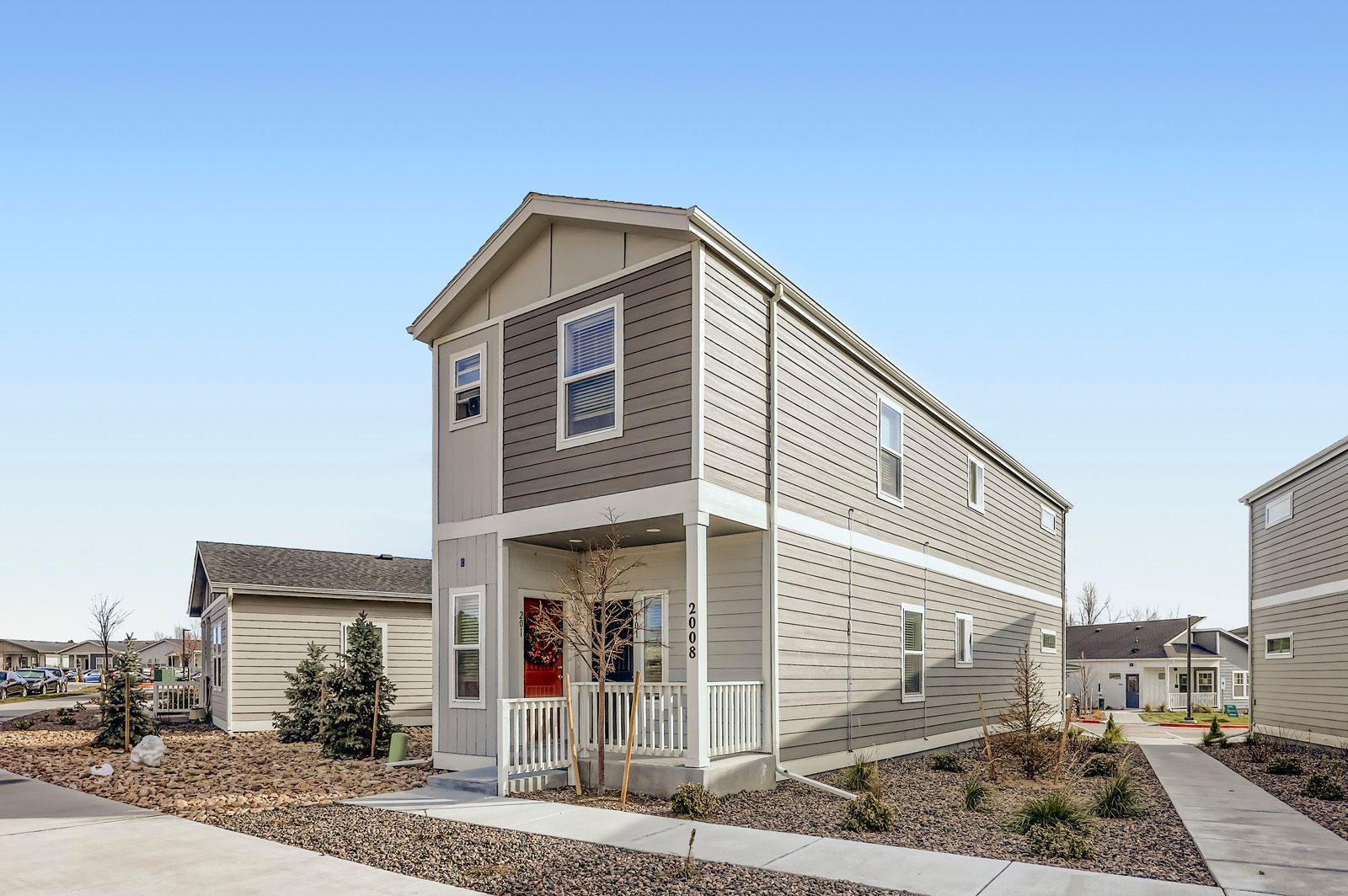
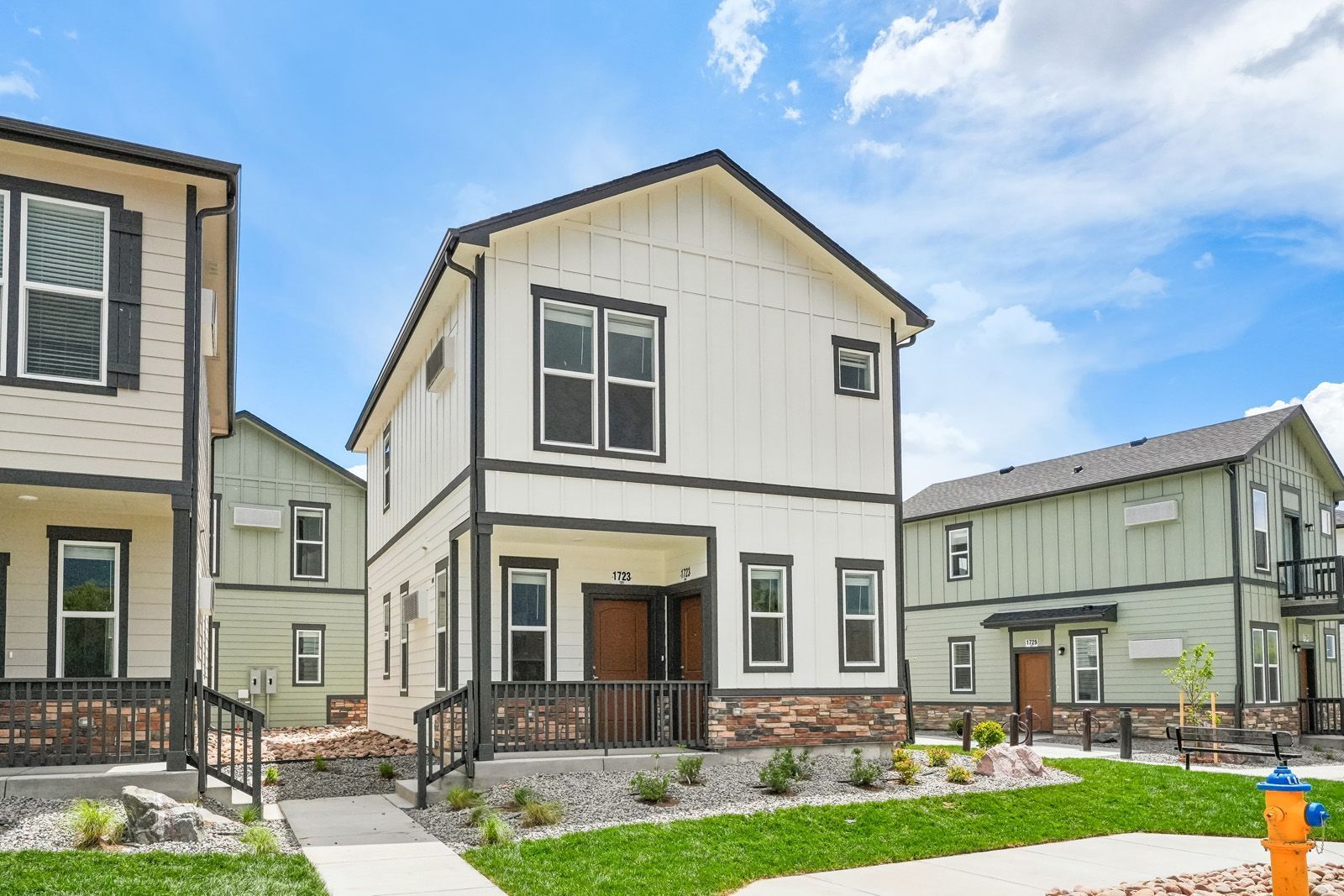
Instead of choosing between apartment living and homeownership, residents can rent a professionally managed single-family home, cottage, duplex, or townhome and enjoy many of the lifestyle benefits traditionally associated with a house—without assuming all of the financial and maintenance responsibilities of owning one.
That doesn't make renting universally better than buying.
It makes the decision considerably more interesting.
Build-to-Rent vs. Homeownership at a Glance
| Consideration | Build-to-Rent | Homeownership |
|---|---|---|
| Upfront Cost | Typically application costs, deposits and move-in expenses | Down payment, closing costs, inspections and other purchase expenses |
| Monthly Housing Cost | Rent plus applicable utilities and fees | Mortgage, taxes, insurance, HOA where applicable and utilities |
| Major Repairs | Generally management/owner responsibility | Homeowner responsibility |
| Exterior Maintenance | Often professionally maintained | Typically homeowner responsibility |
| Equity | Does not build ownership equity | Potential to build equity over time |
| Flexibility | Easier to relocate after lease obligations are fulfilled | Selling can require significant time and transaction costs |
| Customization | Limited by lease/community guidelines | Greater freedom to renovate and personalize |
| Outdoor Space | Yards or patios may be available | Depends on property |
| Privacy | Detached and low-density options available | Typically high in single-family homes |
| Predictability of Repairs | Major property repairs generally aren't an unexpected resident expense | Repairs can create substantial unplanned expenses |
| Long-Term Control | Subject to lease terms and availability | Owner controls how long they remain in the home |
Specific costs, responsibilities, lease terms, amenities and features vary by property and community.
The important difference is that buying and renting accomplish different financial and lifestyle goals.
Understanding those goals matters more than simply comparing a monthly rent payment with a monthly mortgage payment.
A Mortgage Payment Isn't the True Cost of Owning a Home
One of the most common mistakes in the rent-versus-buy conversation is comparing rent directly to a mortgage payment.
Imagine someone considering a rental home for $2,000 per month and a mortgage payment on a comparable house for $2,200.
At first glance, buying might appear to cost only $200 more.
But a mortgage isn't the complete cost of homeownership.
Depending on the property and financing, homeowners may also need to account for:
- Property taxes
- Homeowners insurance
- Mortgage insurance, when applicable
- HOA dues
- Routine maintenance
- Landscaping and lawn care
- Appliance replacement
- Plumbing and electrical repairs
- HVAC maintenance and replacement
- Roof and exterior repairs
- Snow removal or seasonal upkeep
- Unexpected emergency repairs
Not every homeowner experiences every expense every year.
That's part of the problem.
Homeownership costs aren't always predictable.
A perfectly normal month can suddenly include a broken water heater, damaged fence, plumbing problem, malfunctioning furnace, or appliance that needs replacing.
The homeowner isn't calling maintenance.
The homeowner is maintenance—or is responsible for finding and paying someone who can handle it.
That responsibility has real financial value when comparing ownership with professionally managed Build-to-Rent living.
Buying Also Requires Capital Before You Ever Move In
Monthly costs tell only part of the story.
Purchasing a home generally requires significantly more money upfront than renting one.
A buyer may need funds for a down payment, closing costs, inspections, moving expenses, and potentially immediate repairs or improvements after taking possession.
Depending on the purchase price and financing structure, that can mean committing tens of thousands of dollars before spending the first night in the home.
That money isn't necessarily "lost." A down payment becomes part of the buyer's equity in the property.
But it does become less liquid.
Money that might otherwise remain in savings, investments, retirement accounts, a business, education fund, or emergency reserve is now tied to a house.
That introduces something rarely discussed in simple rent-versus-buy calculators:
Opportunity Cost
Every dollar can only be used once.
Someone who puts $50,000 toward purchasing a home has $50,000 invested in that property rather than available for another purpose.
For many households, that's absolutely worthwhile.
For others, preserving liquidity may be more valuable.
A business owner might prefer investing capital into a company. Someone nearing retirement may prioritize diversified investments and cash reserves. A family may want greater financial flexibility. A recent arrival in Colorado Springs may simply prefer learning the city before committing substantial capital to a particular neighborhood.
The right question isn't:
"Is putting money into a house good or bad?"
It's:
"Is putting my money into a house the best use of that money for me right now?"
Homeownership Has One Major Financial Advantage: Equity
Any fair comparison needs to acknowledge the strongest financial argument for ownership.
Homeowners can build equity. Renters don't.
As mortgage principal is repaid, the owner's share of the property generally increases. If the home's market value appreciates, equity can grow further.
Over long periods, homeownership has been an important wealth-building mechanism for millions of American households.
Build-to-Rent doesn't replicate that benefit.
Your rent pays for your right to live in the home during your lease; it doesn't purchase ownership in the property.
For someone who expects to remain in one location for many years, has the financial resources to purchase comfortably, wants to build equity, and is prepared for the responsibilities of ownership, buying a home can make tremendous sense.
But equity isn't free.
It comes bundled with the down payment, transaction costs, financial risk, maintenance responsibilities, and reduced mobility that accompany owning the asset.
The real decision is whether that complete package fits your life.
Flexibility Has Financial Value Too
Suppose you buy a home and two years later receive an incredible job opportunity in another state.
Or your family grows.
Or your children leave home.
Or you begin working remotely and decide you'd rather live somewhere else.
Or you simply discover the neighborhood isn't the right long-term fit.
Homeowners can move, of course.
But moving generally means deciding what to do with the property. Selling involves preparation, marketing, negotiations, closing timelines and transaction costs.
Keeping the home means becoming a landlord or hiring someone to manage it.
Renting works differently.
Once lease obligations have been satisfied, residents generally have significantly more freedom to change where and how they live.
That flexibility can be especially valuable for:
- Military households
- Professionals anticipating career changes
- Remote workers
- People relocating to Colorado Springs
- Recently divorced or separated households
- Families whose space requirements may change
- Empty nesters
- Retirees
- People who simply aren't certain where they want to be five years from now
Flexibility isn't something easily entered into a spreadsheet.
But that doesn't mean it has no value.
Then There's the Cost You Can't Measure: Your Time
Owning a home doesn't only require money.
It requires attention.
Lawns need mowing. Gutters need cleaning. Snow needs clearing. Filters need changing. Sprinklers break. Contractors need scheduling. Something eventually needs painting, repairing, replacing, inspecting, or maintaining.
For some homeowners, that's part of the satisfaction.
There's genuine pride in caring for your own property, improving it, and making it completely yours.
For others, Saturday morning is valuable precisely because they don't want to spend it maintaining a house.
This becomes particularly relevant for people who have already owned homes for decades.
An empty nester selling a larger house may not want to move into an apartment - but they may be completely finished with yard work, exterior maintenance, and wondering what expensive thing will break next.
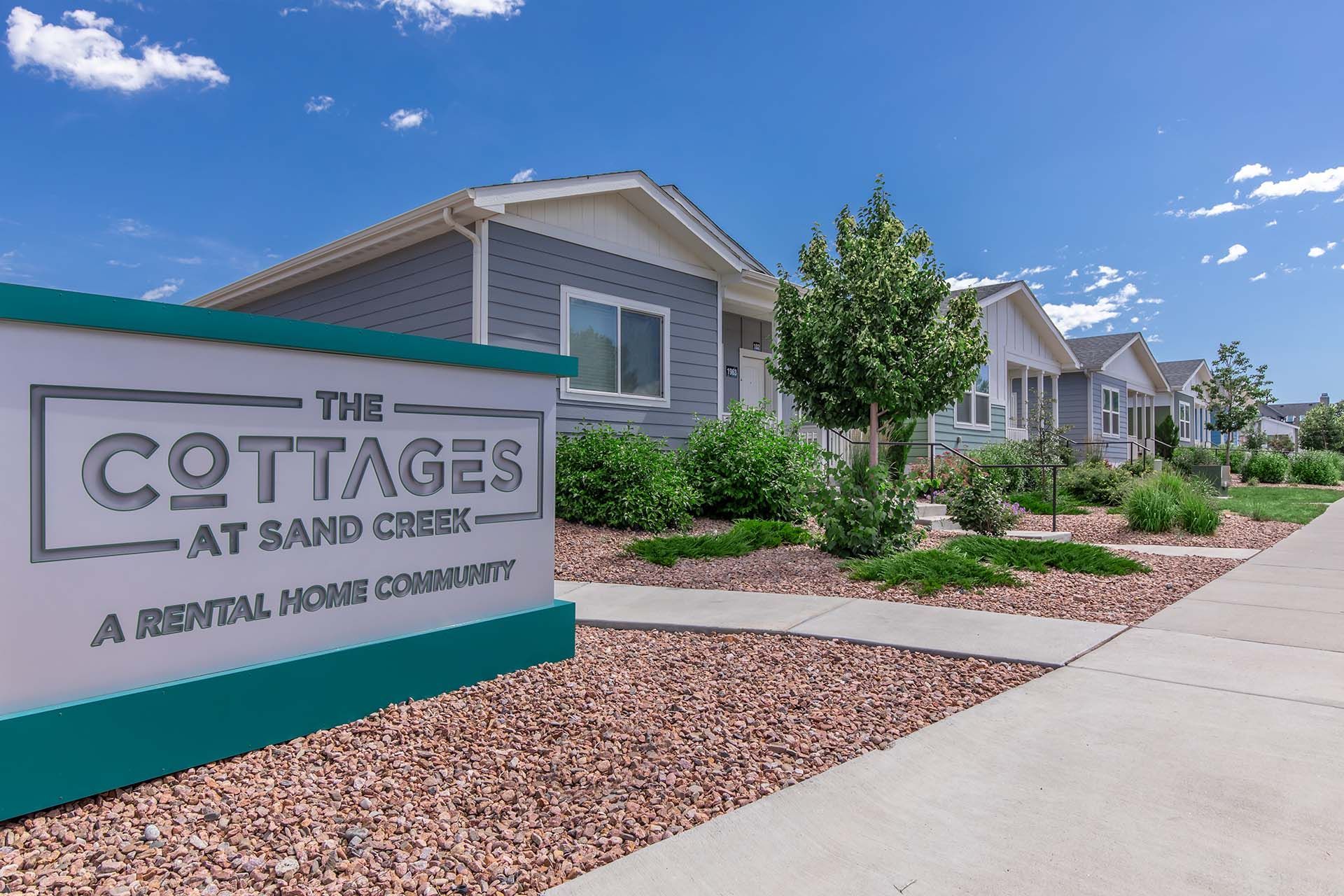
A Build-to-Rent cottage can provide something unusual:
The feeling of downsizing the responsibility without necessarily downsizing the lifestyle.
You can still have your own front door, additional bedrooms, outdoor space, neighborhood surroundings, and privacy - while allowing professional management to handle many of the property responsibilities.
Renting Can Also Be a Strategic Step Before Buying
Build-to-Rent doesn't have to represent a permanent alternative to ownership.
Sometimes it's simply the smarter order of operations.
Consider someone relocating to Colorado Springs.
They could purchase immediately, but that requires making several major decisions at once:
Where should we live?
How long is my commute?
Which part of town fits our lifestyle?
Where do we spend our weekends?
Do we want to be closer to downtown, the mountains, military installations, schools, shopping, or major transportation routes?
A year living in the city can answer questions that a weekend house-hunting trip can't.
Renting a home allows someone to experience the lifestyle they're accustomed to while getting to know the market before making a much larger financial commitment.
If they eventually buy, they may make a considerably more informed decision.
What Do You Give Up by Renting?
Build-to-Rent offers compelling advantages, but there are trade-offs.
Residents generally cannot renovate or modify the property as freely as an owner can.
Want to tear out the kitchen?
Probably not.
Paint every room a dramatically different color?
Check the lease first.
Install permanent landscaping, replace flooring, build a workshop, or redesign the backyard?
Those decisions belong to the property owner.
Renters are also subject to lease terms, community policies, potential rent changes at renewal, and the possibility that a particular home may not remain available indefinitely.
Homeownership provides something renting fundamentally cannot:
Control over the property itself.
If creating a completely personalized home, establishing permanent roots, and controlling your property for decades are central to what "home" means to you, ownership may be worth the additional responsibilities.
So, Is It Better to Rent or Buy?
There's no universal answer - and anyone claiming otherwise is probably trying to sell you something.
Buying may make more sense if you:
- Plan to remain in the same location long-term
- Have sufficient savings beyond the money needed to purchase
- Want to build home equity
- Value control and customization
- Are comfortable accepting maintenance and repair responsibility
- Want the permanence associated with ownership
Build-to-Rent may deserve a closer look if you:
- Want the lifestyle of a house without purchasing one
- Value flexibility and mobility
- Prefer predictable housing responsibilities
- Don't want to commit substantial capital to a property
- Want professional maintenance
- Are new to an area and aren't ready to buy
- Have sold a home and want less responsibility
- Want privacy, outdoor space, or a garage without returning to homeownership
Most importantly, being financially capable of buying a home doesn't automatically mean buying is the best decision.
And choosing to rent doesn't mean someone hasn't "made it."
Housing should serve the life you're living—not dictate what that life is supposed to look like.
A Different Definition of the American Dream
For some people, the American dream will always include owning a home.
For others, the dream may increasingly be about freedom.
Freedom to relocate.
Freedom to invest money elsewhere.
Freedom from unexpected repair bills.
Freedom from spending weekends maintaining a property.
Freedom to choose a different home when life changes.
Build-to-Rent doesn't replace homeownership, nor should it.
What it does is remove an assumption that existed for generations:
You shouldn't have to own a house simply because you want to live in one.
And once you've decided that renting a home might make sense, there's another important distinction to understand.
Because renting a home in a professionally managed Build-to-Rent community isn't necessarily the same experience as renting an individually owned house.
SHARE THIS
Latest Posts